

Funded by the European Union, the project also involves Next Technology Tecnotessile and the Textile Museum. The goal is to create new socioeconomic opportunities through the transformation of textile waste.
The Prato district is also among the protagonists of the European project “Waste2Fashion,” an initiative that aims to transform textile waste into a resource and create new circular and socioeconomic opportunities in the Mediterranean region. Funded by the European Union under the Interreg NEXT MED Program (€2.8 million), the project brings together partners from Spain, Italy, Tunisia, Egypt, and Lebanon to develop and test innovative and replicable solutions for the management of post-consumer textile waste and for circular fashion. The national research company Next Technology Tecnotessile and the Textile Museum in Prato are involved in the project.
Official Project Launch
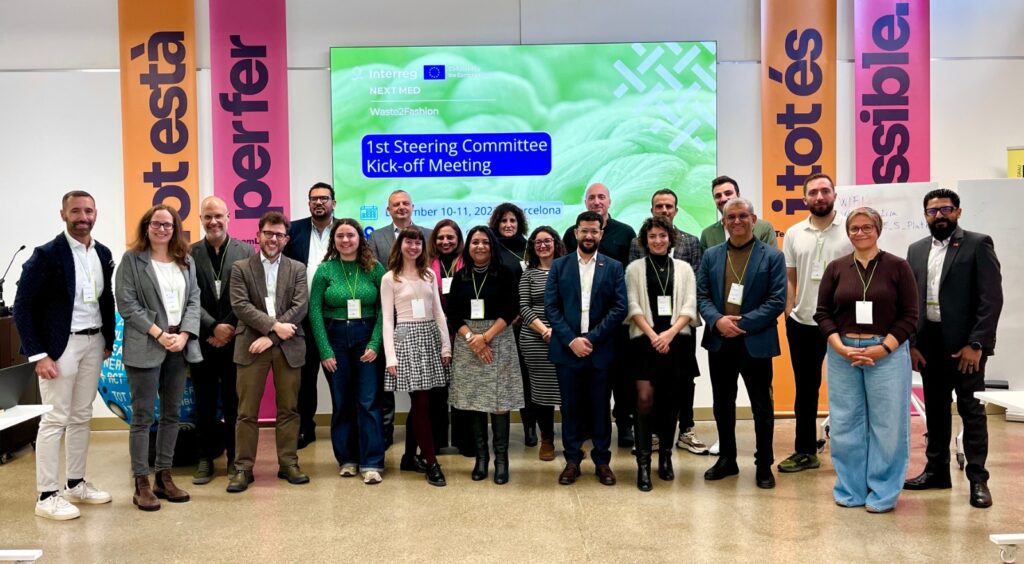
The Waste2Fashion project was officially launched with the first meeting held in Spain at the Barcelona Circular Hub. The event brought together partners from across the Mediterranean region, marking the beginning of a joint effort to address the problem of post-consumer textile waste through innovative circular economy approaches. Hosted by MedWaves, the UNEP/MAP Regional Activity Centre for Sustainable Consumption and Production and the project’s Lead Partner, the meeting laid the foundation for fruitful collaboration in the coming months.
The project
Waste2Fashion, “Development of a pilot circular system for post-consumer textile waste in the Mediterranean,” addresses one of the fastest-growing waste streams globally: textiles. The project will run from 2025 to 2028 with a total budget of approximately €2.8 million, co-financed by the European Union under the Interreg NEXT MED Programme (with an EU contribution of 88.5%).
The goal is to design, test, and validate circular systems that improve the collection, sorting, and pre-recycling of post-consumer textile waste, while promoting sustainable business models and eco-design practices adapted to Mediterranean regions.
Prato’s Role
As mentioned, two Prato-based companies are among the project partners. Next Technology Tecnotessile will promote the reuse and recycling of post-consumer textile waste and develop circular and sustainable business models in the project’s five target regions (Tuscany, Catalonia, Egypt, Tunisia, and Lebanon). Specifically, the national research company will focus on developing small-scale automatic sorting and classification systems for textile materials. Thanks to Waste2Fashion, each region will be equipped with a device aimed at increasing the volume of textile waste given a new life, while also promoting social and employment integration.
The other Prato-based partner is the Museo del Tessuto, which coordinates WP4 – Transnational Eco-design Academy and Circular Acceleration Lab. Its primary task, in collaboration with partners MedWaves, FTTH, and MESMEDA, is to lead the design and delivery of two key tools: the Eco-design Fashion Academy and the Circular Acceleration Lab. The former is a transnational training program for 60 designers and startups from the four participating countries. The latter is an acceleration program for innovative startups that leverage recycled textile materials from post-consumer waste. The Museum is specifically responsible for developing the training content, organizing matchmaking sessions between local producers and designers, and hosting the final transnational event in the Prato textile district. The overall goal is to strengthen skills in eco-innovation and eco-design and foster the integration of circular economy principles into fashion industry business models.
Mission and Strategic Objectives
Waste2Fashion’s mission is to reduce the environmental impact of textile waste while creating economic, social, and innovation opportunities along the fashion supply chain. Through five circular pilot systems for post-consumer textile waste management, the Eco-Design Fashion Academy, the Circular Acceleration Lab, sustainable business plans, and consumer awareness-raising efforts, we will help reduce textile waste going to landfill, improve resource efficiency, strengthen local supply chains, and increase employment opportunities in circular economy sectors.