

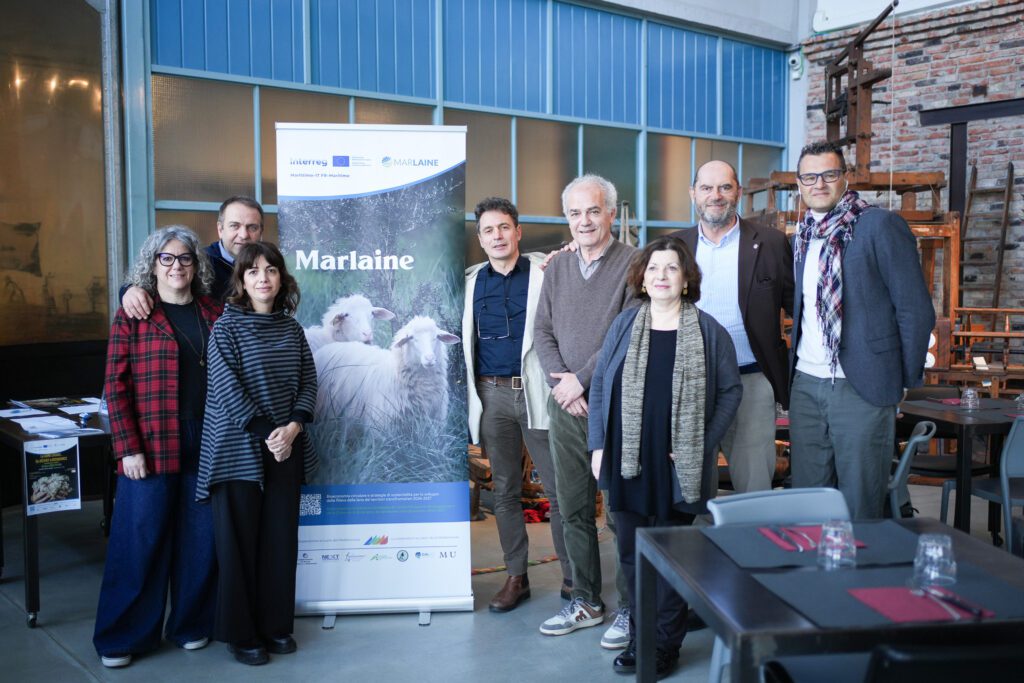
The national research company Next Technology Tecnotessile organized a conference at the Victory Café Museum to discuss new uses for native wool, transforming it from waste to resource. The new prototype micro-washing plant was then presented to European partners.
Revitalizing the wool supply chain in Italy and France, facilitating innovative applications and contributing to the ecological transition. These are the objectives of the European project Marlaine (Circular Bioeconomy and Sustainability Strategies for the Development of the Wool Supply Chain in Cross-Border Territories – Interreg VI-A Italy-France-Maritime Cooperation Program 2021-2027), which bases its activities on the principles of bioeconomy and circularity. The project, which began in March 2024 and is funded with €1.8 million in EU funds, will conclude in February 2027. Among the partners is the national research company Next Technology Tecnotessile, based in Prato. The Prato district hosted the conference on the project “Indigenous Wool: From Waste to Resource” in Montemurlo, in the spaces of the Trafi Creatività Tessile showroom, within the Victory Café Museum. The meeting’s goal was to reflect on the resources present in our regions and to define new virtuous supply chains capable of generating value.
“The Prato district confirms its central role in European projects for recovery, recycling, valorization of natural resources, and innovation,” commented Andrea Falchini, director of Next Technology Tecnotessile. “And in this context, Next Technology plays an important role in research, collaboration between partners, and a vision for an increasingly sustainable future.”
After an introduction by Falchini himself and greetings from Zecchi, president of the Tuscany Fashion Cluster, the project was explored in depth with Dr. Pier Paolo Duce and Dr. Francesca Camilli, who discussed the circular bioeconomy and sustainability strategies for the wool supply chain in cross-border areas. Luisa Ciardi, an industrial archaeologist at the CDSE Foundation, followed, discussing the history of Prato’s textiles, from its medieval roots to the present-day district. Valter Nunziatini, of the Federazione Strade Vino di Toscana, presented the In.Pact project for innovation and knowledge transfer to promote traditional Tuscan agricultural products. Finally, Enrico Venturini, senior researcher at Next Technology Tecnotessile, took stock of wool recycling, focusing on innovation, technological history, and various applications.
“It was a moment of discussion and dissemination of the culture of native wool and how to recover it,” Venturini added. “There are some types of lower-quality wool that are often incinerated or collected using methods that do not enhance their value. With this project, however, we want to explore new uses for these wools, reusing them for new applications in textiles, but also in construction, packaging, and agriculture.”
This afternoon, the Next Technology Tecnotessile headquarters demonstrated the functionality of the prototype micro-washing system. This extremely compact machine, measuring 140 cm wide, 150 cm deep, and 140 cm high, is designed to wash small volumes (4,000–6,000 kg/year) of sheep, cashmere, camel, llama, and alpaca wool. It is suitable for farmers, agritourism businesses, regional associations, local product and tourism promotion organizations, and social welfare and vocational training institutions. The system is equipped with three ultrasonic tanks, and its sophisticated mechanism ensures deeper cleaning than conventional systems, with almost complete removal of foreign matter in the early stages of the process. The result is soft, clean wool as clean as the finest industrial laundries. The system processes 6 kg of greasy wool per hour, ensuring a daily production of approximately 45–50 kg per 8-hour shift.
SDB Comunicazione ©